
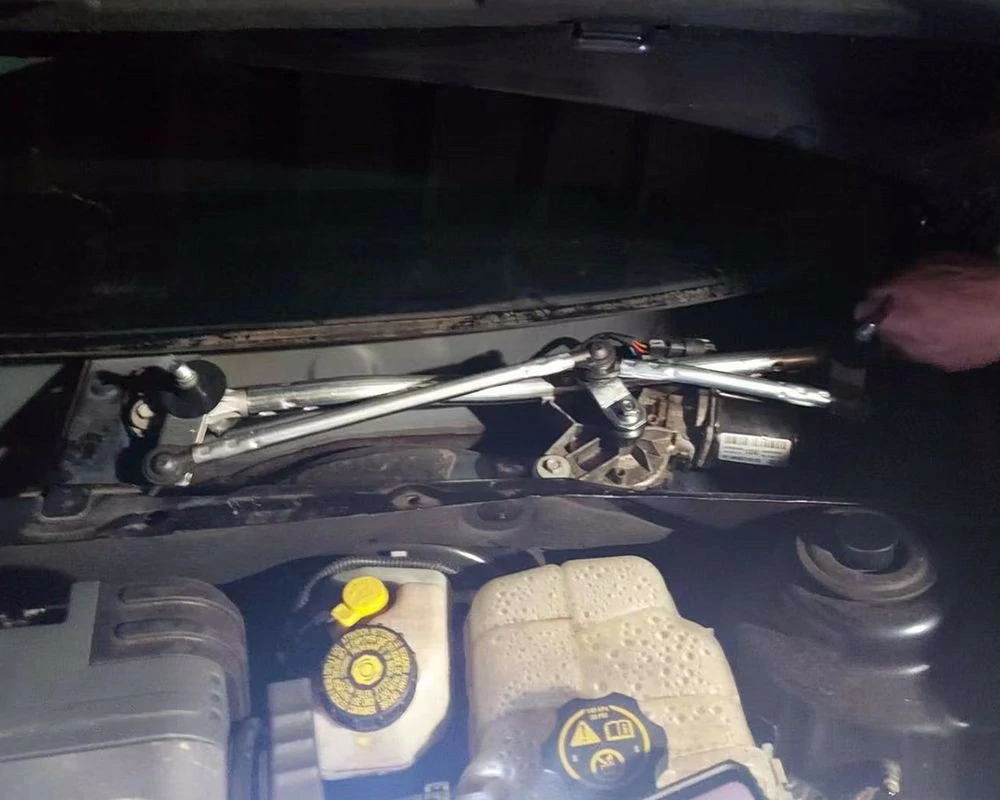
Wipers that knock, sweep on one side only, or stop halfway across the glass nearly always point at the same part: the wiper linkage. The difficulty is that a weak motor, a loose arm nut and worn blades produce very similar complaints. This guide walks through the symptoms one by one, says which part each symptom actually implicates, and explains how to confirm the diagnosis before you buy anything.
What is a windshield wiper linkage?
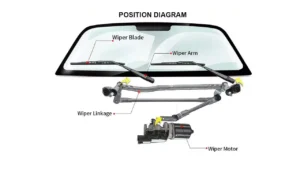
The windshield wiper linkage — also called a wiper linkage assembly or wiper transmission — connects the wiper motor to the wiper arms. It turns the motor’s rotation into the synchronized sweep of the arms, using a drive crank, push rods, a synchronizing rod and the pivot bushings that the arms pivot on. Because the bushings carry the entire load of the system, they are the part that wears first, and most linkage faults begin there. The labeled wiper linkage diagram shows each of these parts in place.
What are the common symptoms of a faulty wiper linkage?
1. Knocking or clunking from the base of the windshield
A rhythmic knock once per stroke, audible inside the car and worst at low speed or in the park position, is the signature of worn pivot bushings. The bushing has worn oval, so the rod moves a fraction before it takes up load and then hits its stop. This is the earliest warning most owners notice — the wipers still clear the glass, so it is easy to ignore until the joint hammers itself apart.
2. One wiper moves while the other stays still
When the two arms stop working as a pair, the fault is almost always inside the linkage — typically a stripped or missing bushing on one side, or a rod end that has worked off its pin. The synchronizing rod is designed to keep both arms in step, so a single-arm failure means that link or its joint has failed. Note that if both arms are completely dead, the motor or its electrical circuit is the more likely cause.
3. The arms cross over, collide, or sweep out of step
Arms that meet in the middle, or sweep with a growing offset between them, point at the synchronizing rod or a bent push rod. The linkage has jumped its designed geometry, which can happen after a joint wears enough to let the rod slip, or after something has bent a rod — impact with ice, or someone forcing a frozen arm by hand. Bent rods should be replaced, not straightened.
4. The arms lag, judder, or stall mid-stroke
Sluggish, jerky movement that gets worse under load suggests the linkage is binding — a seized pivot, a dry joint, or a bushing that has collapsed and is pinching the rod. It is worth comparing the two directions of travel: a linkage fault makes the arms drag and stall, while a failing motor usually slows both directions evenly and is accompanied by a hot or buzzing motor.
5. The arms park in the wrong place, or hit the cowl
If the wipers rest too low, too high, or clout the plastic cowl at the end of the stroke, check two things in order. First the arm nut on the output shaft — a loose nut lets the arm slip on its splines, and re-timing it costs nothing. If the arms are tight and the position is still wrong, the linkage geometry has shifted and the assembly needs replacing.
Linkage, motor, or blades? How to tell them apart
- Linkage — uneven or unsynchronized movement, knocking, one arm only, or arms that have lost their park position. The motor still sounds normal.
- Motor — both arms slow or dead together, a buzzing or hot motor, a blown fuse, or a motor that runs without moving the arms.
- Blades or arm nuts — the arms move correctly but leave streaks, chatter, or the arm slips position on its shaft.
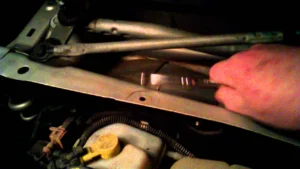
A quick check that separates the two: with the ignition off, grab each wiper arm near its pivot and try to rock it. Any perceptible play, or a click you can feel, means the bushings are worn and the linkage is the problem.
What to do next
If the play is minor and confined to one joint on a low-mileage car, a repair kit may be enough. If the arms wobble at the shafts, more than one joint is loose, or the linkage is more than five years old, the practical answer is a complete assembly — the rods, pivots and bushings are matched to each other, so the original geometry is restored in one go. Find the OE number stamped on the old linkage and match it in our windshield wiper linkage catalog; the step-by-step replacement guide covers the fitting, and our wiper linkage replacement cost guide explains what the job should cost.
Frequently asked questions
Why is my wiper linkage making noise?
A knock or clunk once per stroke is worn pivot bushings. A squeak or scrape is usually a dry joint or a blade chattering on dry glass. A grinding noise can mean a bushing has collapsed and metal is contacting metal, which should be fixed promptly. If the noise comes from under the dash rather than the base of the windshield, look at the motor mounting.
Why does only one wiper move?
Because the synchronizing rod or one joint on one side of the linkage has failed — typically a stripped bushing or a rod end that has come off its pin. The motor is still driving the other side, which is why exactly one arm keeps working. This is a linkage repair, not a motor repair.
How do I know if it is the linkage or the motor?
Test for play first: with the ignition off, rock each arm at its pivot. Any looseness or clicking means the linkage. If the arms are tight but both are slow or dead together, and the motor is buzzing or hot, the fault is in the motor or its wiring. A linkage fault is uneven and noisy; a motor fault is uniform and quiet.
Can a bad linkage damage the wiper motor?
Yes. A binding or seized linkage forces the motor to work against a jammed mechanism, which raises the current draw and overheats the motor, and can eventually burn it out or blow the fuse. That is one reason a knocking linkage is worth fixing early: the part is cheap compared with the motor it can take with it.
Replacement parts for the faults above
If the diagnosis comes back to the linkage, these are the assemblies behind several of the most common cases: Audi Q5 2009-2016 (8R1955023), Nissan Bluebird Sylphy 2006-2017 (28840-EW70A) and Chevrolet Venture 1997-2005 (12365395). Matching by OE number is what guarantees the new unit drops straight in — see the full catalog.
Conclusion
Most wiper linkage complaints resolve to the same short list: worn bushings cause the knock, a failed joint or synchronizing rod stops one arm, and a slipping arm nut or shifted geometry is what moves the park position. Confirming which one you have takes a few minutes with the ignition off, and it decides whether you need a repair kit or a complete assembly. Whatever the answer, matching the replacement by its OE part number is what guarantees the sweep comes back correct the first time.