

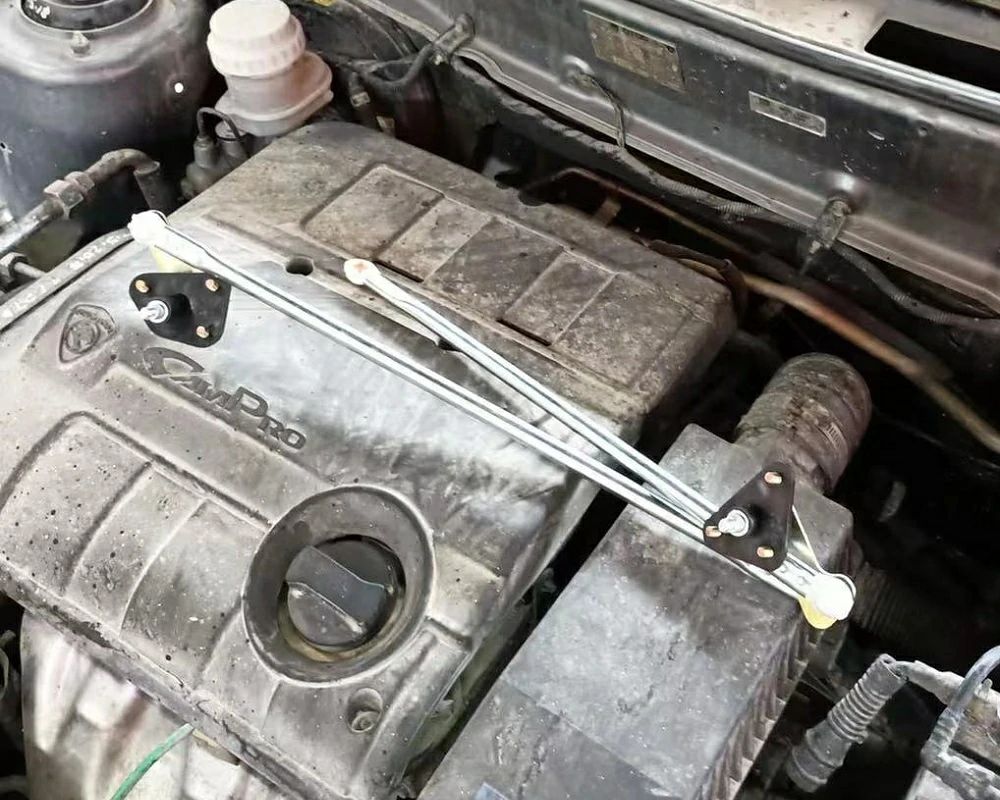
What is a wiper linkage? A wiper linkage (also called a wiper linkage assembly or wiper transmission) is the rod-and-pivot mechanism that connects the wiper motor to the two wiper arms. It converts the motor’s rotating output into the synchronized back-and-forth sweep that clears the windshield, and it consists of four main parts: the drive crank, the push rods, the synchronizing rod, and the pivot bushings and output shafts. When a bushing wears out the arms knock, lag or stop mid-stroke, and the complete linkage is normally replaced as a unit.
What is a windshield wiper linkage?
The wiper linkage serves as a vital mechanical connection in a vehicle’s wiper system, linking the wiper motor to the wiper arms and blades. This in-depth article explains the wiper linkage mechanism, its crucial role, and its significance in facilitating optimal visibility during challenging weather conditions.
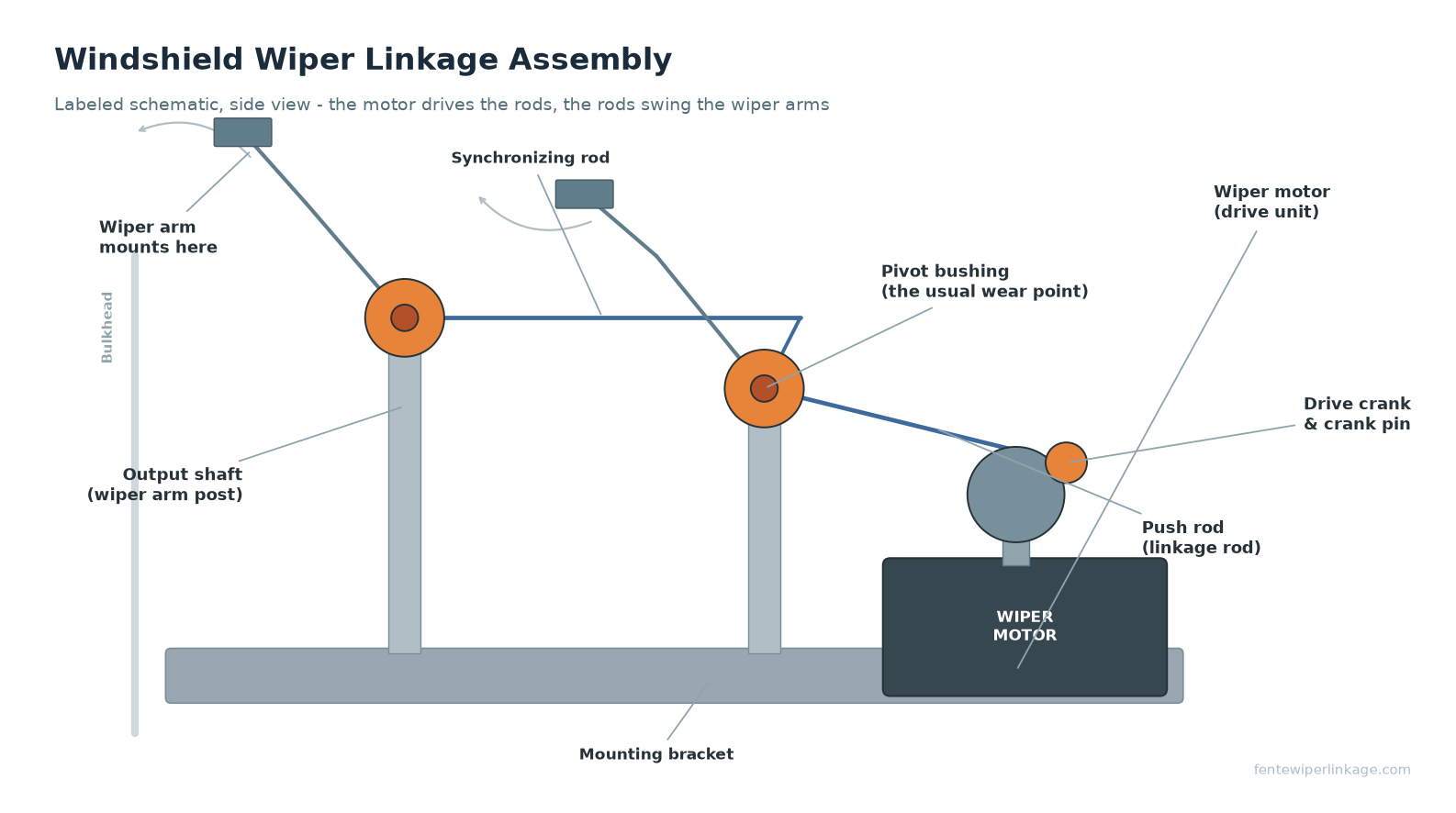
As the diagram shows, the motor’s drive crank pushes the push rods, which rock the output shafts that your wiper arms bolt onto. The pivot bushings are the usual wear point: once they loosen, the arms start to knock, lag or lose stroke. If you are matching a replacement, browse the complete windshield wiper linkage catalog — every assembly is cross-referenced to its original OE part number.
How the wiper linkage mechanism works
The linkage is a four-bar mechanism built around the motor. Follow it stage by stage and every symptom in the troubleshooting list below stops being mysterious:
- The motor spins. The wiper motor runs at one or two fixed speeds and produces nothing but rotation on its output shaft.
- The drive crank turns rotation into an arc. Because the crank pin sits off-centre, the full 360-degree rotation becomes a short back-and-forth swing of roughly 90 to 110 degrees.
- The connecting rods carry that arc outward. Each push rod is a rigid link; it can push and pull along its length but cannot transmit rotation, so whatever motion arrives at its far end is pure swing.
- The pivots change direction and set the sweep. Each pivot bushing and output shaft turns the horizontal push into the arc the wiper arm sweeps across the glass.
- The synchronising link locks both sides together. A second rod ties the two pivots into one closed loop, so both arms are dragged through the same arc at the same moment — that is why one worn bushing makes both arms misbehave, not just one.

Most passenger cars use this parallel layout. Larger windshields often use an opposed or pantograph layout, where the two pivots sit on opposite sides of the motor and the blades sweep in opposite directions; the working principle is identical, only the geometry of the rods changes. Commercial vehicles add a third pivot and a longer synchronising link, but the four-bar logic stays the same. If you are diagnosing a fault rather than replacing a unit, our guide to wiper linkage symptoms and fixes maps each stage of this chain to the symptom it produces.
The mechanism at a glance
| Part | Role in the mechanism | Typical failure symptom |
|---|---|---|
| Wiper motor | Creates the rotation | No movement at all, or one speed only |
| Drive crank | Rotation to arc | Arms parked wrong after a motor change |
| Connecting rods | Carry the arc outward | Arm over-sweeps or hits the cowl |
| Pivot assemblies | Set the sweep angle | Knocking at the base of the windshield |
| Synchronising link | Keeps both sides in step | One arm lags behind the other |
| Pivot bushings | Carry the load at every joint | Play, chatter and lost stroke — the first part to wear |
| Wiper arms / blades | Clear the glass | Streaks — usually a blade, not a linkage, problem |
Buying note for distributors: every stage of this chain is contained in one assembly, which is why linkages are sold complete rather than as individual rods. If you source them in volume, our page on choosing a wiper linkage wholesale supplier covers specifications, MOQ and OEM options in one place.
What are the parts of a wiper linkage?
- Drive crank — the short arm bolted to the wiper motor shaft. It is the input of the mechanism; it never wears out on its own, but it can come loose on its splines.
- Push rods — the connecting links that carry the crank’s movement out to each wiper arm post. Bent rods are the usual cause of an arm that over-sweeps or hits the cowl.
- Synchronizing rod — the link that ties the two arms together so they sweep in step. Excess play here is what makes one arm lag behind the other.
- Pivot bushings — the small plastic or nylon sleeves inside each joint. They take the whole load of the system, and they are the part that fails first on almost every vehicle.
- Output shafts (arm posts) — the splined stubs the wiper arms clamp onto. A loose arm nut here is often mistaken for a failed linkage.
- Frame or bracket — the stamped mounting plate that bolts the assembly to the body and sets the geometry.
What is the function of the wiper linkage?
- Transmitting power: the linkage transfers the rotational force of the wiper motor to the wiper arms and blades, so the blades can sweep rain, snow and ice off the glass.
- Synchronized movement: it keeps the two arms moving together and maintains even pressure between blade and windshield, which is what prevents streaks and unwiped gaps.
- Load distribution: it spreads the motor’s force evenly across both arms, so no single joint carries more than its share.
- Durability: the rods, pivots and bushings are chosen to resist heat, corrosion and constant cycling, which is why a healthy linkage outlasts several sets of blades.
The same part is sold under several names depending on the catalog — wiper linkage, wiper transmission linkage, wiper linkage assembly or wiper motor linkage. They all describe the complete rod-and-pivot unit described above. For the more common question of what a replacement costs, see our wiper linkage replacement guide.
Maintenance and troubleshooting
Regular maintenance of the wiper linkage is essential for optimal performance and longevity. Here are the maintenance steps and the symptoms worth acting on:
- Lubricate: periodically apply a silicone-based lubricant to the joints and pivots to reduce friction and prevent excessive wear.
- Inspect for damage: check for bent rods, loose connections and play at the output shafts, and deal with anything loose before it damages the joint.
- Replace as a unit: once the linkage is badly worn, fit the complete assembly rather than individual joints — mismatched rods are a common cause of draggy, uneven sweeps.
- Watch the early symptoms: a knock at the base of the windshield, one arm lagging behind the other, or arms parking in the wrong place all point to the linkage. Our guide to diagnosing wiper linkage symptoms separates linkage faults from motor and blade faults.
Frequently asked questions
What are the parts of a wiper linkage?
A complete linkage has four working parts: the drive crank on the motor shaft, one or two push rods, a synchronizing rod that ties the two arms together, and the pivot bushings and output shafts that the wiper arms mount on — all carried on a stamped frame or bracket. The bushings are the part that wears first.
What is the difference between the linkage and the motor crank?
The motor crank is the small arm fixed to the wiper motor’s output shaft; it is the input to the mechanism. The linkage is everything downstream of it — the rods, synchronizing link, pivots and bushings that turn that single rotation into the sweep of both wiper arms. A crank can come loose, but the wear that causes most faults happens inside the linkage joints.
Which part of a wiper linkage usually fails first?
The pivot bushings. They carry the full load of the motor through every stroke and are made of plastic or nylon, so they wear oval before anything metal fatigues. Once a bushing develops play, the rod hammers its joint and the failure spreads, which is why the assembly is normally replaced as a complete unit.
Is a wiper linkage the same as a wiper transmission?
Yes. Catalogues use wiper linkage, wiper linkage assembly, wiper transmission and wiper motor linkage interchangeably for the same rod-and-pivot unit. The only term that means something different is wiper motor — that is the drive unit only, sold separately. When you order, match the OE number on the old assembly and the catalogue name stops mattering.
How does the linkage keep both wiper arms synchronised?
Through the synchronising link, which closes the rods and pivots into a single four-bar loop. Because the loop is rigid, the two output shafts are geometrically forced to sweep the same arc at the same time — no electronics are involved. That is also why synchronization failures feel like a timing problem but are almost always a worn bushing or a bent rod inside the loop.
One more example of a complete unit: the wiper linkage for the Nissan Sunshine 2011 (OE 28800-1HB2A) shows how the rods and pivot housings are arranged on a small-car assembly, with the OE number printed on the main rod.
Conclusion
The wiper linkage is an essential component of the wiper system, responsible for translating the rotational motion of the wiper motor into the back-and-forth motion of the wiper blades. Understanding its parts and its failure points makes both maintenance and replacement straightforward. If you need a replacement, match it by the OE number on the old unit — our wiper linkage catalog lists every assembly with its original part number, and the step-by-step fitting guide covers the installation.
Browse wiper linkages by vehicle series
Every assembly in the windshield wiper linkage catalog is cross-referenced to the OE part number stamped on the old unit. Jump straight to a vehicle series: VW Series wiper linkages, Peugeot Reno Series wiper linkages, Mazda Series wiper linkages or Honda Series wiper linkages.


One Response